Designing (Another) Onboarding Journey
Honeydew is a dating + social app which pairs users according to their Myers-Briggs Personality Type.
The target user base for dating apps had largely habituated to how a standard dating service operates, making the onboarding process for most of these apps straightforward.
However, Honeydew’s particular quirk added an interesting challenge to the mix.
These were the original Profile Maker screens. Users must click through all four screens in order to complete the account-initiation process:
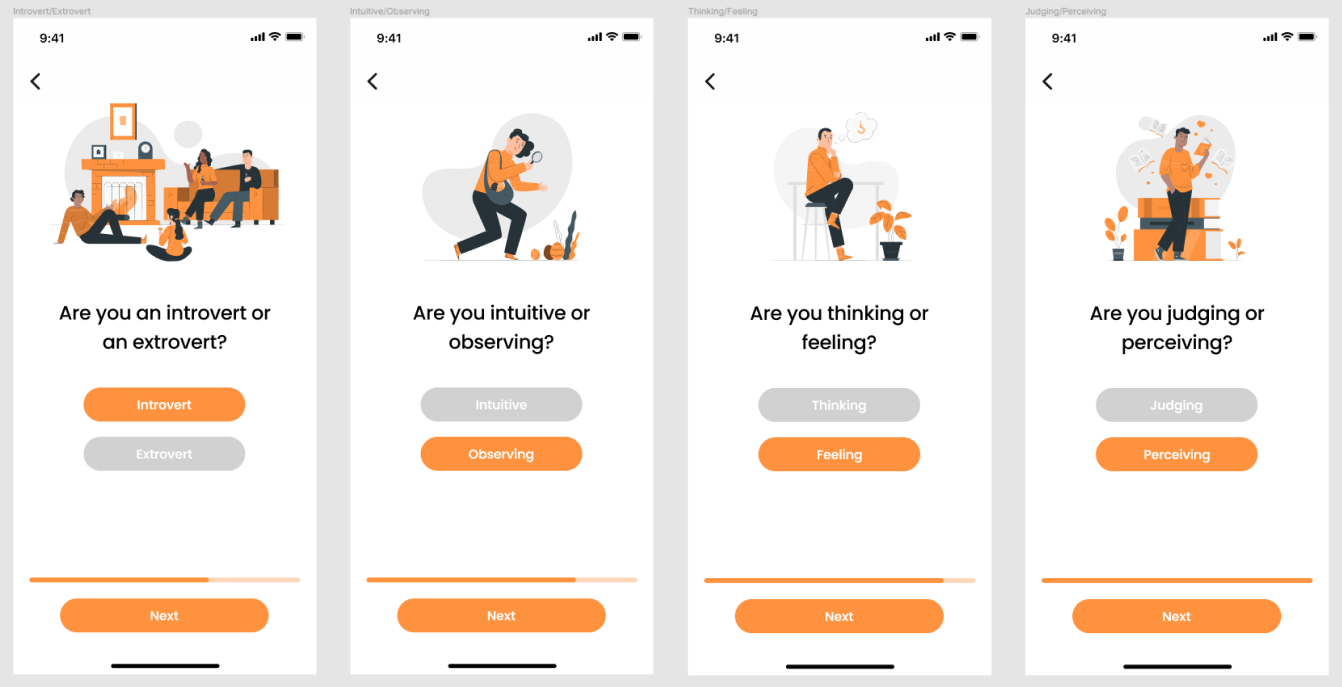
The questions and their choices needed more context, but putting more text in this flow would cause too much friction.
Honeydew’s onboarding process aimed to determine the Myers-Briggs personality type of a new user through four simple screens.
To a user who has taken the Myers-Briggs test, these jargons made a modicum of sense. They could complete the four screens using their memories of the test.
Other users were out of luck.
Here was my improvement:

I reframed the questions into prompts (which needed no additional context), and rewrote their corresponding choices.
For example, the original qualifier “Observing” could be interpreted in multiple ways. The Myers-Briggs test itself needed three paragraphs to explain all aspects of an “Observing” personality. “Observers” are focused on the present; hands-on; prefer immediately actionable options over distant prospects. In fact, from the definitions, Observers don’t seem to be very “observant.”
I absorbed those three paragraphs, condensed relevant portions, and chose “idealistic” as the replacement term. I was only interested in the dating and general socialization aspects of the definition, and decided “idealistic” to be a good summary.
Furthermore, I uncapitalized the qualifier choices. “Complete the sentence” made this onboarding journey feel more interactive and natural.